7:11 AM | Posted in

Light significantly accelerates hydrogen generation from formic acid, according to a report by German scientists. Combining the process with a small fuel cell could create a power source suitable for replacing batteries in laptops and other mobile devices, they claim.

"A significant step forward in the sustainable production of hydrogen from renewable hydrogen donors" - Serafino Gladiali, University of Sassari, Italy
Matthias Beller and colleagues at the University of Rostock used a ruthenium catalyst to break down formic acid into hydrogen, which can be used to power a fuel cell, and carbon dioxide. They found that shining a light on the reaction mixture increased the reaction rate, meaning they could turn hydrogen production on or off by controlling the light source. To demonstrate the potential of their system, the team created a miniature, hydrogen-powered car.

Category:
��
7:10 AM | Posted in

More than 5.5 billion kilograms of toxic pollutants were released and transferred by nearly 35,000 industrial facilities throughout North America in 2005, according to new data presented by the US Commission for Environmental Cooperation (CEC).

The group's 10 June report concludes that approximately 90 per cent of this pollution in the US, Canada and Mexico can be traced to 30 substances from 15 industrial sectors, including chemical manufacturing.

The top contributing sectors varied by country, but key culprits in the US were chemicals manufacturing, primary metals and mines. Oil and gas extraction, primary metals and wastewater treatment activities topped Canada's list, and the top polluting sectors in Mexico were metal mines, electric utilities and electrical equipment manufacturing.

Overall, the report found that the North American petroleum industry was responsible for a quarter of the toxic pollutants reported by all sectors in 2005, the most recent year for which data was available.

The US accounted for more than 80 per cent of all reporting facilities, versus 12 per cent for Canada and 6 per cent for Mexico. Of the pollutants reported, several - including lead, arsenic and nickel - are known or suspected carcinogens and developmental or reproductive toxicants, as well persistent, bioaccumulative and toxic substances.

Results from this latest report, however, do seem to support findings from a 2007 CEC study that toxic releases in the US and Canada are dropping. Releases fell by 15 per cent between 1998 and 2004, a pattern that appears to have continued according to the latest findings.

'We do intend to take a look again at those sorts of trends in the future for all three North American countries,' project coordinator Danielle Vallee tells Chemistry World. 'We might examine specific pollutants of concern, like the mercuries, leads, and others that people might think to prioritise a bit more.'

Interestingly, while there was a 50 per cent increase in the number of facilities reporting toxic releases and transfers in Canada between 1998 and 2005, in the US the number fell by 11 per cent. Some of these US facilities may no longer exist, or alternatively, CEC suggests that production may have been lower in 2005, falling below the annual reporting threshold of 11,000 kg for many chemical substances.

Comparing chemical releases and transfers across North America is complicated by differences in industrial makeup, pollutant coverage and reporting requirements of the three countries. There is also variation in terms of methods used to estimate releases, and the accuracy of reporting.

Nevertheless, the CEC - an international organisation created under the North American Agreement on Environmental Cooperation - suggests that its report can provide insight into further actions required to enhance international comparability of chemical release data and improve understanding of industrial pollution in North America.

Rebecca Trager, US correspondent for Research Europe

Interesting? Spread the word using the 'tools' menu on the left.

Category:
��
7:08 AM | Posted in

American chemists have developed an 'electronic glue' to link nanocrystals together - allowing groups of the crystals to be highly conductive. Since nanocrystals have unique optical and electrical properties, this research could provide some exciting new materials for use in light-emitting devices or solar cells.

Nanocrystals are crystalline nanoparticles of metals ranging from cadmium to silicon, and can be grown with precisely controlled size and shape. But despite their exciting range of optical properties, they have found few applications so far.

'The problem is getting the crystals to 'talk' to one another,' says Maksym Kovalenko, lead author on the project at the University of Chicago, US, 'And this problem arises from the way the crystals are made.'

Organic ligands are used to control and stabilise nanocrystals during their synthesis, Kovalenko explains, which results in the crystals being sandwiched between layers of insulating material. Although individual nanocrystals are semiconducting and have found niche applications - such as in making quantum dots or acting as fluorescent biological markers - electrical charge is restricted from passing through larger groups.

Instead of using organic ligands, Kovalenko's team discovered that some metal chalcogenide complexes can work the same way but do not shield the crystals from the transfer of electrical charge. In one example, the team used a ligand exchange process to switch the organic ligands on gold nanocrystals for a tin sulphide complex of Sn2S64-.

The mixture was then heated gently, which left a tight honeycombed structure of gold nanoparticles surrounded by charge-heavy ligands - creating a highly conductive solid material. Other crystals and complexes are also under investigation by the team, who are confident that this technique can be applied to many other systems.

Category:
��
7:07 AM | Posted in

Researchers in the US have adapted a DNA amplification technique to develop a simpler way to rapidly screen chemical reactions. The process should improve reaction screening methods known as 'chemical speed-dating' - where hundreds of different substrates are mixed together but only a few interact strongly.

These reaction screens are a great way to quickly probe chemical space to discover new reactions, and this new technique builds on the polymerase chain reaction (PCR) to eliminate some awkward processing steps, boost efficiency and accuracy.

The speed-dating process works by attaching hundreds of different substrates to short, single strands of DNA. When warmed to 60°C, the strands are too short to pair up naturally - but where two substrates have reacted, their DNA tails pair up, forming a short piece of DNA that resembles a hairpin.

Traditionally, one of the substrates typically needs to be mounted on a bead to isolate and identify the compounds that have reacted, which can be a time-consuming practice. Now, David Liu's team at Harvard University, US, have simplified the method by modifying the polymerase chain reaction (used to copy single strands of DNA millions of times) to selectively replicate only the DNA strands where a reaction has occurred.

Category:
��
7:06 AM | Posted in

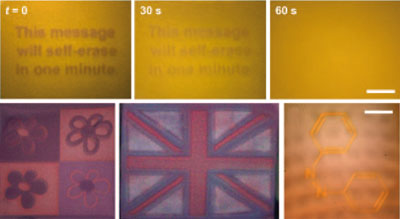
Materials displaying 'self-erasing' colour images have been created by chemists in the US, who have studied how certain nanoparticles can assemble and disassemble themselves under different wavelengths of light.

The materials, which are printed with ultraviolet (UV) light and erased with visible light, could one day be used for self-expiring bus tickets or for carrying secret messages.

'Self-erasing papers are important for time-sensitive materials and secure communications,' said study leader Bartosz Grzybowski of Northwestern University in Evanston, Illinois. 'On the fundamental level, what we describe is also a very different way of looking at the concept of information storage. We're not using traditional coloured inks per se, but rather we "generate" or "elicit" colours only when particles in the film self-assemble.

Category:
��